
We may earn money or products from the companies mentioned in this post.
Nootropics Depot sells its caffeine and L-theanine capsules in two versions with very similar bottles. One version gives 100 mg caffeine plus 200 mg L-theanine. The other reverses those amounts, so each capsule holds twice the caffeine.
That choice matters more than any promise of “smooth energy.” This review covers mainly the 100/200 mg version and keeps the 200/100 mg version separate. It also checks the label, the human research, the posted lab reports, and the cost per capsule.
Our early verdict: it’s convenient and well documented if you already want these exact fixed doses. It’s a weaker fit if you want to adjust caffeine and theanine separately. This is a researched review, not a hands-on test.
Quick facts: two strengths, two bottle sizes, one capsule per serving
Some searches call this product tablets. The manufacturer’s listing identifies both strengths as capsules.
| Label detail | Manufacturer listing |
|---|---|
| Primary strength | 100 mg caffeine and 200 mg L-theanine |
| Higher-caffeine strength | 200 mg caffeine and 100 mg L-theanine |
| Serving size | One capsule |
| Bottle sizes | 60 or 180 capsules |
| Listed entry price | $19.99 |
Where it does well: a simple two-ingredient formula, clearly stated amounts per capsule, and lot-specific lab reports for the main strength.
Where it falls short: a fixed ratio and caffeine that still adds up across your day. The studies also tested the ingredients, not this brand’s capsules.
What’s in each capsule, and why the two strengths aren’t interchangeable
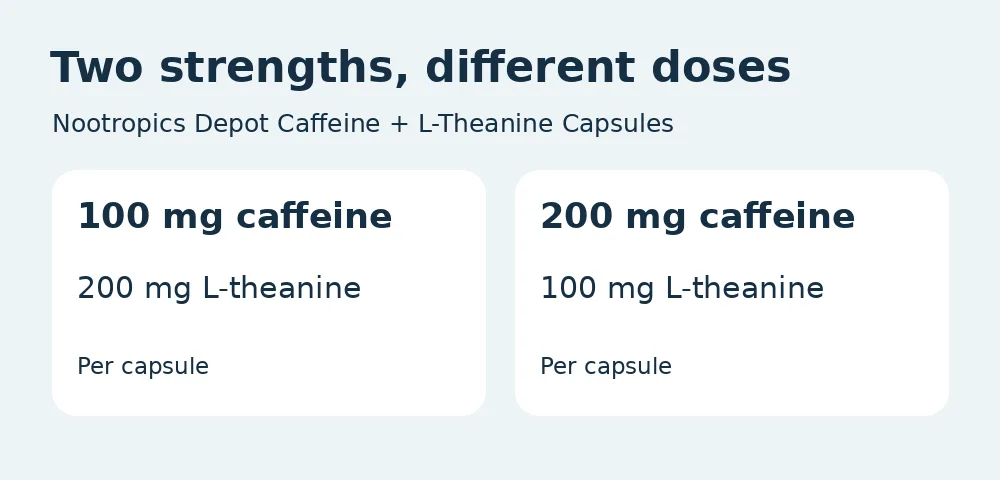
100/200 mg vs 200/100 mg: same ingredients, double the caffeine
One capsule of the reversed formula gives the caffeine of two primary capsules, with half the theanine. When you compare prices or read other reviews, check which strength the information covers. The caffeine dose differs twofold.
Neither ratio is a proven best dose for everyone. A ratio only describes proportions, while your body responds to the actual milligrams you take.
The fixed pairing is the main trade-off. You can’t lower the caffeine without also lowering the theanine.
Opening or splitting capsules for a smaller amount isn’t supported by the label. Buyers who want that control would need to buy the two ingredients separately.
Inactive ingredients and what’s still unverified on the label
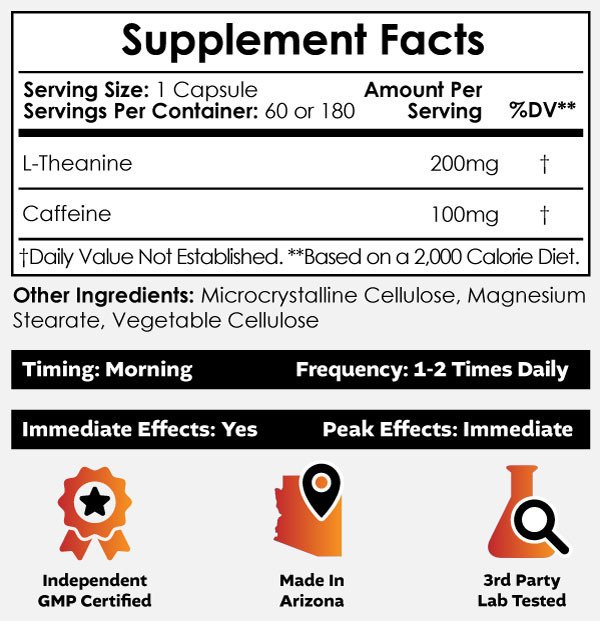
The primary formula’s readable Supplement Facts image lists these other ingredients: microcrystalline cellulose, magnesium stearate and a vegetable cellulose capsule. Caffeine anhydrous is simply a dried, concentrated form of caffeine.
Check the full label on the bottle you receive for warnings and storage directions.
Use our free supplement-label comparison worksheet to compare active amounts and serving costs.
Is there human research behind these doses?
Partly. A few small, short trials support the caffeine and theanine pairing. However, we didn’t find any trial of this finished product or of either exact dose pair.
A 2025 systematic review and meta-analysis found possible short-term benefits on some attention tasks in healthy adults. Effects varied by task and timing.
Each study below lists caffeine first and theanine second.
| Study | Caffeine / L-theanine | Results |
|---|---|---|
| Owen et al. (2008) | 50 mg / 100 mg | Some attention-switching and distraction measures improved versus placebo. Caffeine alone also helped on some measures. |
| Haskell et al. (2008) | 150 mg / 250 mg | Some attention and mood measures improved. One delayed word-recognition measure showed an interaction. |
| Giesbrecht et al. (2010) | 40 mg / 97 mg | Switching accuracy and self-rated alertness improved versus placebo. No caffeine-only group. |
| Einöther et al. (2010) | 40 mg / 97 mg | Task switching improved. Self-rated alertness did not improve significantly. No caffeine-only group. |
What these studies can and can’t tell a buyer
The key question is whether theanine adds anything beyond caffeine. Only Owen and Haskell included a caffeine-only group, and caffeine alone produced benefits in both. Haskell’s reported interaction covered one specific measure, not every task.
Giesbrecht and Einöther compared the combination only with placebo. Beating placebo doesn’t show what theanine contributed on top of caffeine.
Owen’s 50/100 mg pair matches the primary formula’s ratio but uses half the amounts. Don’t assume the effects scale up evenly with dose.
Owen’s participants avoided caffeine from the previous evening, and Haskell’s went at least 12 hours without it. Some benefit may reflect relief from mild caffeine withdrawal, though the papers don’t prove that explains everything.
The outcomes were short lab tasks and mood ratings in healthy adults. None of this shows better grades, long-term memory, ADHD treatment, brain protection or lasting productivity.
Can L-theanine cancel caffeine’s jitters, crash or sleep problems?
The studies reviewed here measured short-term performance and mood. They do not establish that adding L-theanine prevents jitters, a crash or sleep disruption from these capsules.
Theanine doesn’t remove any caffeine from the capsule. The trials above lasted hours, not weeks, so they say nothing about tolerance, withdrawal or long-term safety.
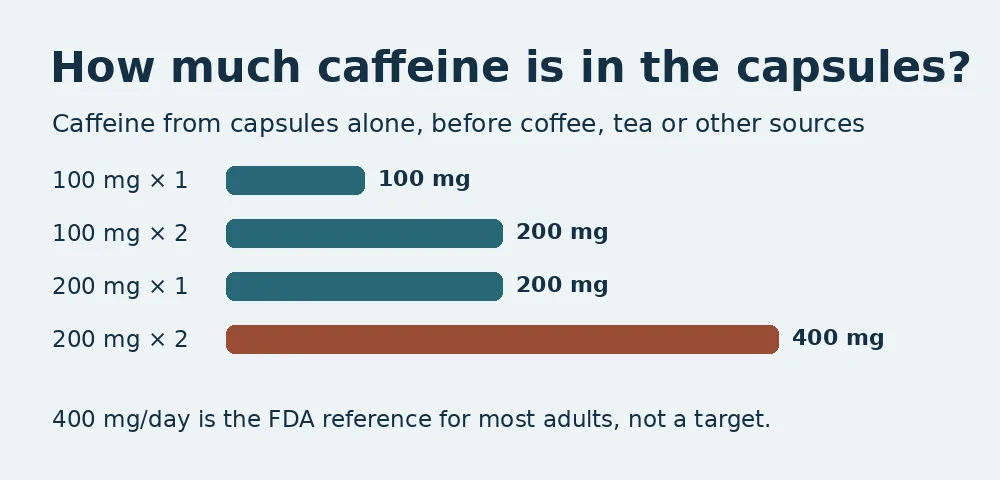
The FDA cites 400 mg per day as an amount generally tolerated by most adults. Individual sensitivity varies, and caffeine from every source counts toward your daily total.
The label suggests taking it in the morning, one to two times daily. Two primary capsules add 200 mg caffeine. Two reversed capsules add 400 mg before any coffee, tea, energy drinks or pre-workouts.
Caffeine can still cause anxiety, jitters, a racing heart, stomach upset and poor sleep. Talk with a clinician first if you take medication, have a medical condition, or are pregnant or breastfeeding.
What the posted lab reports show and what they don’t
The product page links lot-specific certificates of analysis (COAs) for the two formulas.
| Formula | Manufacturer-posted report |
|---|---|
| 100/200 mg, 60 capsules | CLTCS1062226A |
| 100/200 mg, 180 capsules | CLTCS1080426 |
| 200/100 mg, 180 capsules | C2LT1CS1101926 |
Independence needs context too. Omnient Labs runs the testing, and Nootropics Depot says it was originally set up to test the brand’s products.
Nootropics Depot says its owner established Supplement Logistics, its primary contract manufacturer. The brand also describes its relationship with Omnient Labs, which prepares the finished-lot reports.
What it costs per capsule, and how Zhou compares
The official listing shows a $19.99 entry price. We couldn’t confirm prices for all four strength and size combinations, so check your exact variant at checkout.
If $19.99 applies to the 60-capsule 100/200 mg bottle, that’s about $0.33 per capsule. That works out to roughly $10 for 30 one-capsule servings before tax and shipping. The same math doesn’t apply to the 180-capsule bottle or the reversed formula.
Zhou Energy + Focus is another fixed-dose option with a published price.
| Product | Per capsule | Cost per capsule |
|---|---|---|
| Nootropics Depot 100/200 mg | 100 mg caffeine, 200 mg L-theanine | About $0.33 if the 60-count bottle is $19.99 |
| Zhou Energy + Focus | 100 mg caffeine, 200 mg L-theanine | About $0.35 at $20.89 for 60 |
Zhou identifies its caffeine as naturally sourced. Its listing displayed a sold-out notice, so check availability.
Separate caffeine and theanine products give you full control over each amount. We didn’t verify current prices for that route, so we can’t say whether it saves money.
Questions buyers ask before ordering
Can you take it with coffee?
You can, but every cup adds caffeine on top of the capsule. Coffee strength varies widely, so count all your caffeine sources together.
Can you return an opened bottle?
The manufacturer’s return policy says it accepts unopened products within 30 days of delivery and that the customer pays return shipping.
Will the lab report match the bottle you receive?
Not always. Compare the lot number on your bottle with the posted COA, because the newest report may not match the stock that ships.
Should you buy Nootropics Depot Caffeine + L-Theanine?
It’s a sensible buy for adults who already want 100 mg caffeine with 200 mg theanine in one capsule. Its strongest point is transparency: clear doses, a readable label and lot reports that closely match the primary formula’s label.
The biggest limitation is the locked ratio, and the unopened-only return rule makes a poor fit costly. If the entry price holds, about a third of a dollar per capsule is reasonable value. The research supports the ingredient pairing for short tasks, not this product’s specific benefits.
If you’re caffeine sensitive or want to fine-tune each dose, separate ingredients are the better route.
View the current capsule options and prices at Nootropics Depot.